
Who is Maria Montessori?
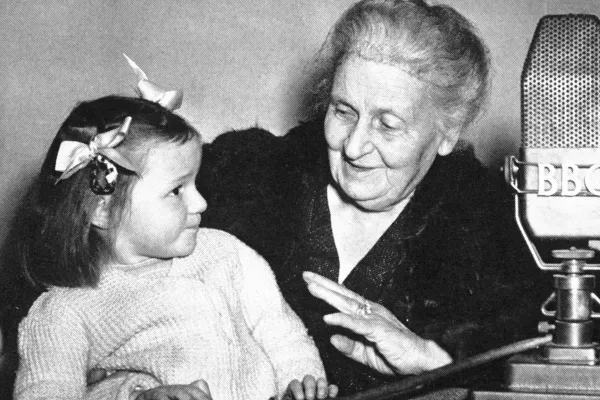
Maria Montessori was a renowned Italian doctor and educator, born in 1870. Her revolutionary approach to early childhood education was based on her experience and observation of children in hospitals and classrooms. In 1907, she founded the first Casa dei Bambini (Children’s House) in Rome, where she first applied her educational method known as Montessori. Montessori method.Through her methodology, Maria Montessori sought to promote autonomy, independence and the holistic development of children, recognizing their innate potential to learn and grow. Her work attracted international attention and recognition, becoming one of the most influential voices in the field of education. Throughout her life, Maria Montessori dedicated her efforts to creating an educational approach that respected each child’s individuality and laid the foundation for a more human-centered education focused on developing human potential.
Holistic and Integral Education
Montessori is more than a teaching method; it is a social philosophy based on respect for life and a deep consideration of human potential. It is a call to the highest human virtues, such as love, affection, generosity, responsibility for our own actions, forgiveness, compassion, and openness to one another. It guides us to share, rather than accumulate, towards cooperation, rather than competition, and towards peace, rather than violence.
If education recognizes the inherent value of the child’s personality and provides an environment that fosters spiritual development, a completely new child is revealed to us—whose remarkable qualities over time can contribute to the betterment of the world.
One can be very skilled in their studies, in their work, and capable of arguing with great wit and reasoning, but that is not intelligence. Intelligence goes hand in hand with love and compassion; and as an individual separated from others, one cannot access that intelligence.
J. Krishnamurti
Key Concepts of Pedagogy
Each of the following concepts contributes to creating a unique child-centered educational approach that seeks to promote the child’s holistic development and foster a love for learning.
- Holistic Development: The Montessori method aims to promote the holistic development of each child, addressing their physical, emotional, social, and cognitive needs. It focuses on the balanced growth of all aspects of the person.
- Prepared Environment: A carefully prepared learning environment is created, where materials and activities are accessible and suitable for the child’s development. The environment is organized, orderly, and stimulating, fostering independence and self-discipline.
- Autonomy and Responsible Freedom: Montessori pedagogy emphasizes the child’s autonomy, allowing them to choose their learning activities and work at their own pace. Children take responsibility for their actions and learn to make informed decisions.
- Montessori Materials: Specially designed teaching materials are used, which are to be manipulated by the children. These sensory and educational materials encourage discovery and understanding through hands-on experimentation. Each material has a specific purpose and is introduced sequentially.
- Educator as Guide: The role of the educator in Montessori pedagogy is that of a guide or facilitator. They observe and understand each child’s individual needs, offer support when necessary, and encourage the development of autonomous skills. The educator creates a safe and respectful environment that allows children to explore and learn independently.
- Active and Sensory Learning: Children learn through direct experience and physical contact with their surroundings. The Montessori method promotes active and sensory learning, where children use all their senses to explore and understand abstract concepts.
- Long-term Education: The Montessori methodology extends beyond early childhood and adapts as children grow. It continues through adolescence, addressing the changing needs of students at each stage of development.
The Four Planes of Development
«The child does not develop uniformly day by day at the same pace. Growth has crises similar to the metamorphosis of insects.»
Maria Montessori was a pioneer in creating a pedagogical approach for each developmental stage, based on observing the nature of the child. She defined four stages:
- Red Plane of Infancy (0 to 6 years): From 0 to 3, the main tool is the unconscious absorbent mind, and from 3 to 6, the conscious absorbent mind. During this period, personality is formed, and the development of movement, hand use, reality, and language acquisition and enrichment are crucial.
- Blue Plane of Childhood (6 to 12 years): This is a calm period of uniform growth, where the abstract mind organizes itself. Children have a need to explore morality and a constant hunger for culture. Key tools include reasoning, imagination, moral awareness, the concept of justice, the need for congruence and consistency from adults, a thirst for knowledge about the world and the universe, and the affirmation of individual personality.
- Red Plane of Adolescence (12 to 18 years): Due to puberty, significant physical, psychological, and relational changes occur within the family and society. This is a delicate time, as the social individual is created but has not yet fully developed.
- Blue Plane of Maturity (18 to 24 years): Physical development and social personality are completed, with a strong focus on self-awareness and self-realization. Spiritual strength and independence are acquired, allowing individuals to find and fulfill their personal mission in life.
The four planes of development are distinguished physically, mentally, and socially. They are universal, though they can be influenced by obstacles or facilitations presented. Each stage is the foundation for the one that follows, and if not fulfilled, it will continue to affect the individual throughout life. The preparation of the guides for each plane must be different.
 English
  Spanish